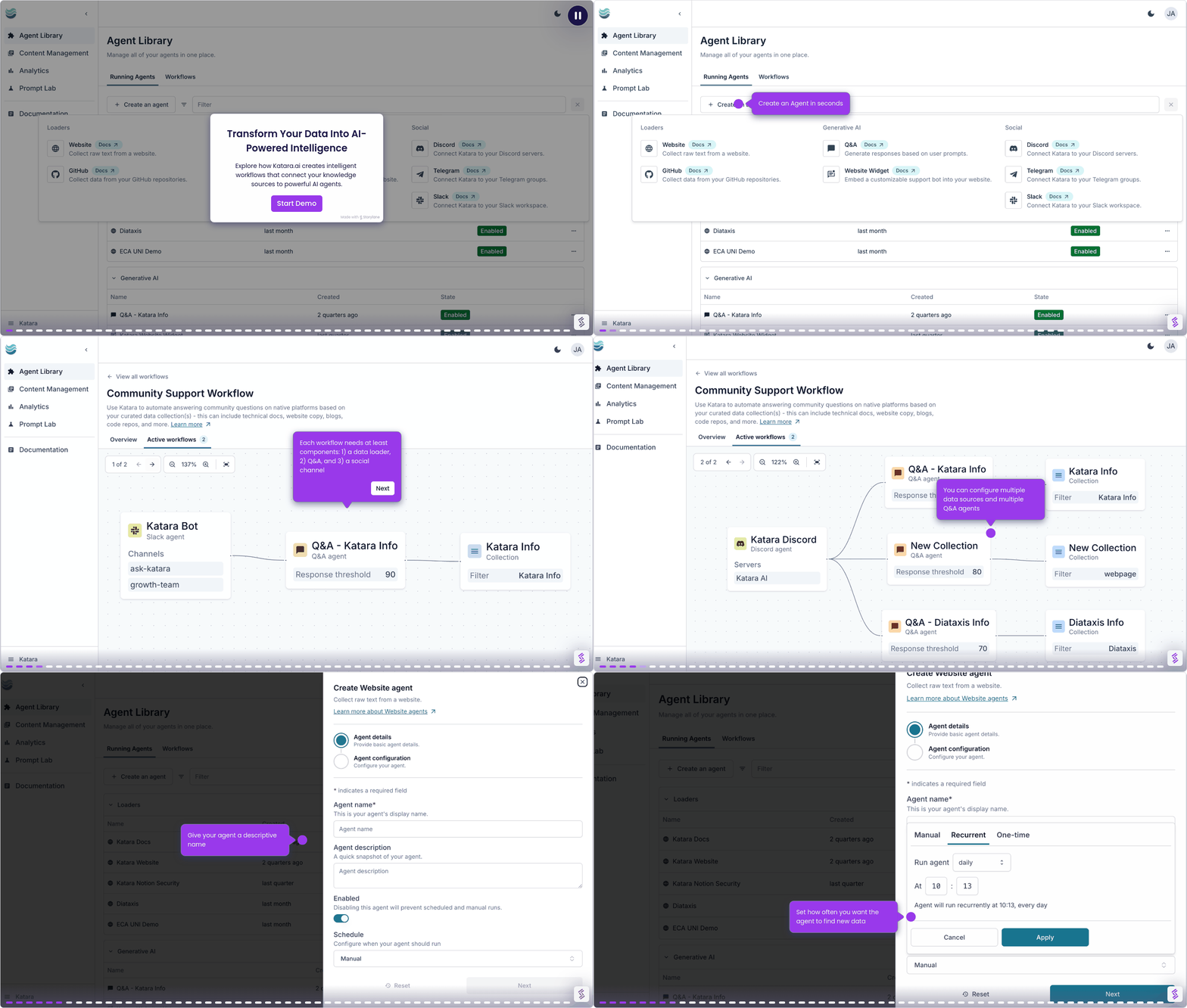
We've made RAG infrastructure a non-issue, so you focus on building killer agentic apps.
However, if you want to try to do it yourself here is a crystal-clear step-by-step guide to building it yourself.
All Necessary Steps to Create a RAG Infrastructure
Building a Retrieval-Augmented Generation (RAG) infrastructure from scratch involves setting up a system that combines data retrieval with generative AI (like LLMs) to deliver accurate, context-grounded responses. This is core to agentic apps, but it's complex requiring data handling, vector tech, security, and ops. Below, we outline every essential step in sequence, including prerequisites, core build, and post-launch optimization.
Katara's multi-agent backend automates these milestones, slashing setup from weeks to hours.
STEP 1.
Planning Phase: Define Requirements and Scope (Time: 1 - 2 weeks)
- Gather application goals: What problem are you solving? (E.g., Q&A on docs, chatbots, knowledge bases.) Specify use cases, performance needs (latency, accuracy), scale (data volume, users), and constraints (budget, compliance like GDPR/HIPAA).
- Identify data sources: Collect accessible data (e.g., PDFs, CSVs, APIs, web pages). Ensure it's clean, legal, and relevant scan for PII/sensitive info.
- Choose tech stack: Select LLMs (e.g., OpenAI, Claude, Grok, GPT), embedding models (e.g., OpenAI embeddings, Hugging Face), vector DB (e.g., Pinecone, Weaviate), and infra (cloud like AWS/GCP or on-prem).
STEP 2.
Set Up Data Ingestion Pipeline (Build Time: 1 week)
- Build connectors: Create scripts/APIs to pull data from sources (e.g., web scrapers, database queries, file uploads). Use tools like Apache Kafka or Airbyte for streaming/batch ingestion.
- Handle data formats: Parse unstructured (text, images) and structured data (JSON, SQL). Clean noise, deduplicate, and enrich (e.g., add metadata).
- Implement lineage tracking: Log data origins for auditing (critical for compliance).
- Why necessary: Garbage in = garbage out #GIGO. Automate for real-time updates.
STEP 3.
Process and Chunk Data (Build Time: 2 - 3 weeks)
- Chunking strategy: Break data into manageable pieces (e.g., 512-token chunks with overlap). Use semantic chunking (via LLMs) for better context vs. fixed-size.
- Preprocessing: Tokenize, normalize (stemming, lemmatization), and filter irrelevant content.
- Enrichment: Add summaries, entities, or relations (e.g., via NER tools).
- Why necessary: Optimizes retrieval too big chunks lose precision; too small lose context. (DON'T UNDERESTIMATE THE IMPORTANCE OF THIS)
STEP 4.
Generate Embeddings / Vectorization (Build Time: 1 week)
- Select embedding model: Fine-tune or use pre-trained (e.g., Sentence Transformers).
- Embed chunks: Convert text to dense vectors (e.g., via API calls to embedding services).
- Handle multimodal: If including images/audio, use models like CLIP.
- Why necessary: Enables semantic search vectors capture meaning beyond keywords.
STEP 5.
Set Up Vector Database and Indexing (Build Time: 1 - 2 weeks)
- Choose/deploy DB: Provision a scalable vector store (e.g., FAISS for local, Milvus for distributed).
- Index vectors: Upload embeddings with metadata. Use HNSW/IVF for fast approximate nearest neighbors (ANN) search.
- Configure shards/partitions: For large-scale, ensure horizontal scaling.
- Why necessary: Powers efficient retrieval at query time.
STEP 6.
Implement Retrieval Mechanism (Build Time: 1 week)
- Build query pipeline: Embed user queries, then retrieve top-k similar chunks (e.g., cosine similarity).
- Add reranking: Use models (e.g., Cohere Rerank) to refine results post-retrieval.
- Hybrid search: Combine vector + keyword (BM25) for robustness.
- Guardrails: Filter for relevance/safety (e.g., block toxic content).
- Why necessary: The "R" in RAG without it, you're just generating hallucinations.
STEP 7.
Integrate with Generation Model LLMs (Build Time: 2- 3 days)
- Prompt engineering: Craft templates to feed retrieved chunks + query to LLM (e.g., "Based on [context], answer [query]").
- API setup: Connect to LLM provider (e.g., xAI Grok API, OpenAI).
- Handle context limits: Compress/truncate if needed.
- Why necessary: Augments generation with grounded facts for accuracy.
STEP 8.
Build Query Handling and API Layer (Build Time: 1 week)
- Create frontend/backend: UI (e.g., Streamlit/ChatGPT-style) or API (REST/GraphQL) for user inputs.
- Orchestrate flow: Query → Embed → Retrieve → Rerank → Generate → Respond.
- Add caching: Store frequent queries to reduce latency/cost.
- Why necessary: Makes the system usable expose via SDKs for integration.
STEP 9.
Add Security, Compliance, and Access Controls (Build Time: 3 - 6 weeks)
- Implement auth: Role-based access (e.g., OAuth, JWT) for data/users.
- Encrypt data: At rest/in transit; audit logs for traceability.
- Compliance checks: Scan for PII, ensure data sovereignty (e.g., region-specific storage).
- Rate limiting: Prevent abuse/cost overruns.
- Why necessary: Avoid breaches/fines essential for production.
STEP 10.
Deploy and Monitor Infrastructure (Build Time: 1 week)
- Provision infra: Use Kubernetes/Docker for scalability; cloud autoscaling.
- CI/CD pipeline: Automate deployments (e.g., GitHub Actions).
- Monitoring: Track metrics (latency, accuracy, costs) with tools like Prometheus/Grafana. Set alerts for anomalies.
- A/B testing: For models/chunking strategies.
- Why necessary: Ensures reliability optimize iteratively (e.g., fine-tune based on logs).
STEP 11.
Test, Evaluate, and Optimize (Ongoing 20 - 40 hours per week)
- Unit/integration tests: For each component (e.g., retrieval recall/precision).
- Benchmarks: Use datasets like RAGAS for end-to-end eval.
- Feedback loop: Log user interactions; retrain embeddings if needed.
- Cost optimization: Monitor token usage; switch models.
- Why necessary: RAG isn't set-it-and-forget-it continuous improvement drives ROI.
STEP 12.
Scale and Maintain (Ongoing 5 - 10 hours per week)
- Horizontal scaling: Add nodes for traffic spikes.
- Versioning: Track changes to pipelines/models.
- Backup/DR: Regular snapshots; disaster recovery plans.
- Why necessary: Handles growth key for enterprise adoption.
This covers every step from zero to production-ready RAG. Total time/cost for a dev (who knows what they are doing): 8-12 weeks + $5K+ in cloud fees, plus ongoing ops headaches.
Fast-Track Your AI Infra, Use Katara Instead
Why grind through this manually? Katara's agentic magic backend automates ingestion, chunking, vectorization, safety, deployment, and monitoring. Upload data, done in hours, with built-in cost optimization, observability, and guardrails. It's the "prompt-first" dev's dream: No infra expertise needed.
We've got limited beta spots open sign up now at for free access.
Let's chat! What's your first RAG use case?