


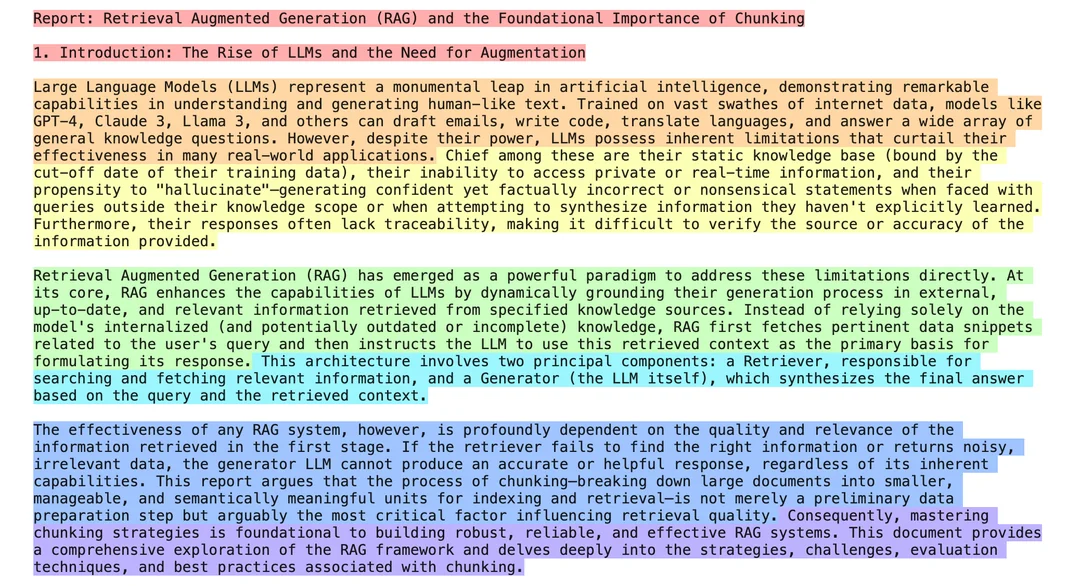
As a prompt-first developer building agentic applications, you’ve likely hit the "RAG Wall." You have the data, you have the LLM, but the responses are lackluster. One of the biggest culprits? Chunking.
The consensus is clear: outdated chunking methods are silently killing the efficiency and accuracy of RAG pipelines.
If you are aiming to scale your AI app from a prototype to a production-ready system without wasting weeks on infrastructure trial-and-error, understanding these issues is crucial.
In this post, we’ll break down why traditional chunking fails, actionable strategies to fix it, and how automate the process quickly
For the uninitiated, chunking in Retrieval-Augmented Generation (RAG) involves splitting large documents into smaller segments for embedding into vector databases. This allows LLMs to retrieve relevant context without exceeding token limits.
The default methods specifically fixed-size character splitting are creating more problems than they solve. Here are the key gripes:
Fixed-size chunks are arbitrary. They often split sentences or paragraphs mid-thought, destroying context.
"It's like tearing a book page in half, the LLM gets half the story and hallucinates the rest."
This fragmentation leads to irrelevant retrievals and low-quality generation because the "chunk" loses its relationship to the surrounding ideas.
Code snippets, Markdown tables, PDFs, and unstructured web pages all require different handling. A generic chunking strategy fails to respect syntax.
While adding "overlap" (e.g., repeating 20% of text between chunks) helps preserve some context, it creates storage bloat. Thread participants described this as a "pray-and-spray" approach: embedding everything and hoping the top-k retrieval makes sense. It wastes tokens, increases latency, and drives up compute costs.
Naive chunking might work for a 10-page PDF, but it explodes when applied to large datasets. One developer noted that when experimenting with 500k+ documents, retrieval accuracy tanked because chunks became either too generic to be useful or too specific to be found.
Here are four proven ways to level up your chunking game:
Stop using arbitrary character counts. Use a lightweight LLM or embedding model to identify natural semantic breaks, such as topic shifts or paragraph conclusions.
Build a pyramid structure. Embed small, fine-grained chunks for precise vector search, but link them to larger "parent" chunks that contain the full context.
One size does not fit all. You need a pipeline that detects the format and adjusts accordingly:
"Use metadata enrichment—tag chunks with type, source, and hierarchy to enable hybrid search (vector + keyword)."
Don't "set it and forget it." Implement a feedback loop where you chunk, embed, and query test sets using frameworks like RAGAS to measure fidelity. A/B testing chunk sizes (e.g., 512 vs. 1024 tokens) allows you to scientifically balance cost and accuracy.
Implementing semantic, hierarchical, and adaptive chunking is not trivial. For a solo dev or a small team, building these custom pipelines turns into months of lost productivity.
Developers using the Katara beta have reported much faster RAG deployment and significatly better accuracy, allowing them to focus on what matters: customer acquisition and core features.
If you are tired of broken chunking slowing down your build, it’s time for a backend that works as hard as you do.
Sign up for Katara today or schedule a free consultation to see how we can optimize your RAG pipeline. Let's turn your agentic vision into revenue-generating reality.
What chunking challenges have you faced? Drop us a message at hello@katara.ai or hit us up on X @KataraAI. Together, we're redefining AI development.
*Image source: https://www.reddit.com/r/Rag/comments/1jyzrxg/a_simple_chunking_visualizer_to_compare_chunk/
Backed by


